


-
Latest
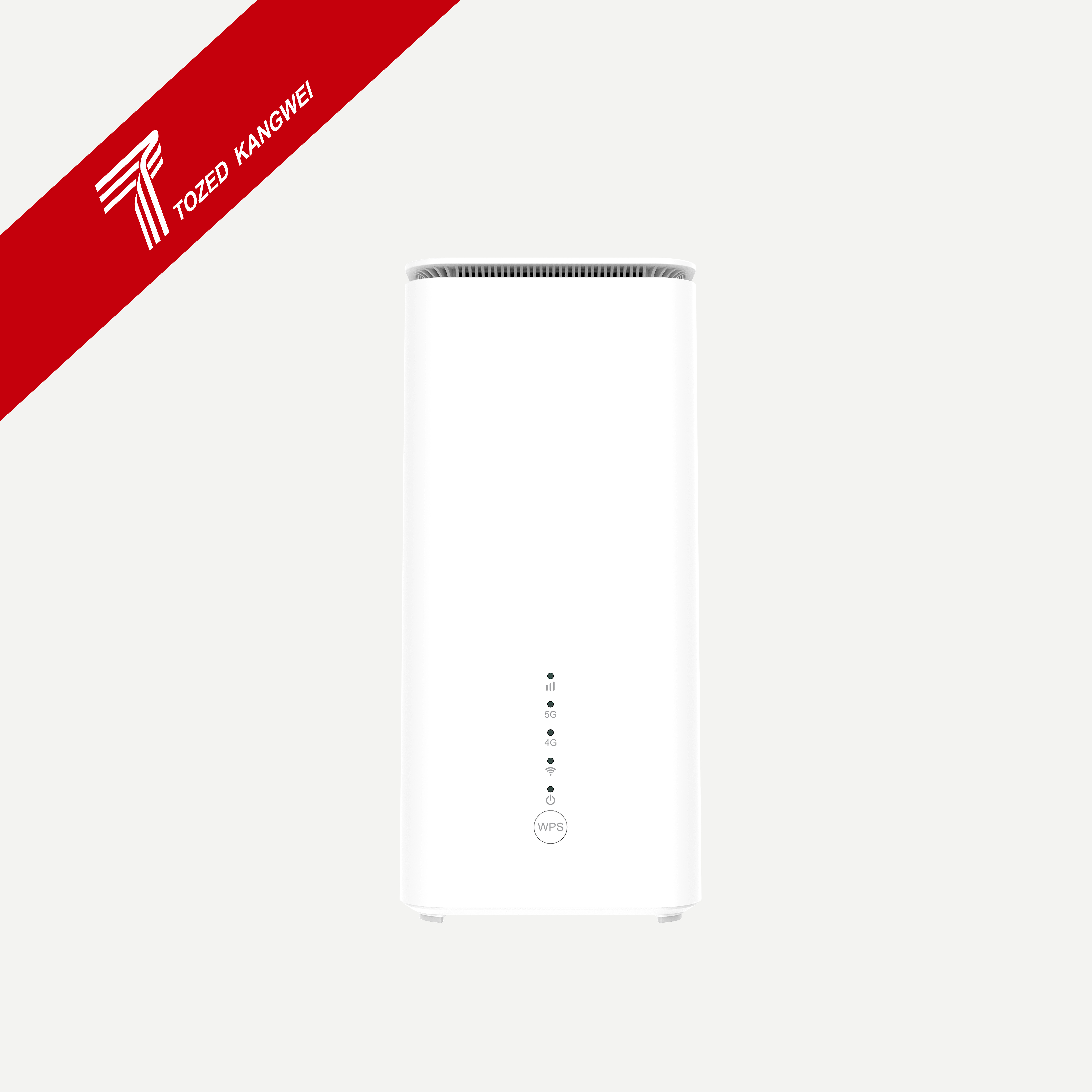 5G Indoor CPE-ZLT X25 Series




Stay Updated with Tozed Kangwei
U6GHz: Finding the Balance for 6G Spectrum | Tozed Kangwei Accelerates Industry Readiness from the Terminal Side
Date: 2026.09.30


6G Spectrum Outlook
Every generation of mobile communications has relied on the development and utilization of new spectrum resources.
4G primarily operates below 3GHz, while 5G has expanded into the 3.5GHz, 4.9GHz, and millimeter-wave bands. Looking ahead to 6G, networks will need not only greater capacity and higher data rates, but also a balance between coverage, deployment costs, and industry maturity.
Among the various candidate spectrum bands for 6G, 6425–7125 MHz has attracted significant attention. Spanning the 6GHz and 7GHz ranges, this spectrum is commonly referred to as the Upper 6GHz band, or U6GHz.
Why is it so important?
The answer can be summed up in one word: balance.
01 | 6G Needs More Spectrum
The amount of data that wireless communications can carry is closely related to the amount of usable spectrum available. Video services, cloud applications, and smart devices continue to drive mobile data traffic upward. As 6G emerges, new scenarios such as immersive communications, AI and communications convergence, and integrated sensing and communications will further increase network capacity requirements.
The ITU's IMT-2030 Framework identifies six usage scenarios: immersive communication, hyper reliable and low-latency communication, massive communication, ubiquitous connectivity, AI and communication convergence, and integrated sensing and communication.
Coding, antenna technologies, and network architectures can continue to improve spectral efficiency, but these gains are not unlimited. To achieve greater system capacity, additional spectrum and wider channels will remain critical.
The 6425–7125 MHz range provides approximately 700 MHz of continuous spectrum, creating room for wider channels and greater capacity. This is the first reason why U6GHz has attracted attention.

Figure 1 | Evolution of mobile communications spectrum

Figure 2 | Six usage scenarios defined by the ITU for IMT-2030
02 | Higher Frequency Does Not Always Mean Better
If 6G needs more bandwidth, why not simply move to millimeter-wave or even higher terahertz frequencies?
These higher-frequency bands offer abundant spectrum resources. However, radio waves generally experience greater propagation loss as frequency increases, while their ability to penetrate buildings and overcome obstacles is also reduced.
As a result, millimeter-wave technologies are more suitable for localized high-capacity scenarios such as stadiums, transportation hubs, and commercial districts. Even higher-frequency bands still face challenges related to propagation, device technologies, and deployment costs, and are currently used primarily in areas such as short-range high-speed communications and advanced sensing research.
ITU-R M.2160 indicates that IMT-2030 is expected to utilize a broad range of frequencies, from below 1GHz to above 100GHz. Within this spectrum landscape, mid-band spectrum plays an important role in balancing coverage and network capacity.
Compared with lower frequencies, it can provide larger blocks of continuous bandwidth.
Compared with millimeter-wave frequencies, it is more conducive to achieving broader and more continuous coverage.
Between bandwidth, coverage, and engineering requirements, it provides another balanced option.
Of course, U6GHz still experiences greater propagation loss than existing 5G bands such as 3.5GHz. Actual coverage will also depend on factors including base-station power, antenna configurations, network architecture, and building environments. It is therefore not simply a direct replication of the coverage capabilities of existing 5G networks.

Figure 3 | Illustration of coverage characteristics at different frequencies

Figure 4 | Relationship between coverage and available bandwidth
03 | Continuity with the Existing 5G Technology Ecosystem
Another practical advantage of U6GHz is that it does not move far away from today's mobile communications technology ecosystem.
Large-scale 5G deployments today make extensive use of spectrum around the 3–5GHz range. Although U6GHz operates at a higher frequency, it remains within the mid-band spectrum range.
This means that the experience accumulated during the 5G era in areas such as massive MIMO, beamforming, RF components, base-station deployment, and network optimization can continue to provide valuable technical references.
Whether a spectrum band can become an important resource for next-generation mobile communications cannot be determined solely by peak data rates achieved in laboratories. It also depends on whether networks can be built with sufficiently broad coverage, acceptable costs, and commercially viable terminals.
This is where U6GHz presents an important distinction from higher-frequency bands: it is oriented toward the future while retaining a degree of continuity with the existing industry foundation.

Figure 5 | Continuity between U6GHz and the existing 5G technology ecosystem
04 | U6GHz Is Not the Only Spectrum Band for 6G
Mobile networks have never relied on a single spectrum band. Future 6G networks will likewise be supported by multiple bands working together.
Lower-frequency bands will continue to provide wide-area coverage. Mid-band spectrum will balance coverage and capacity. Higher-frequency bands can provide greater bandwidth in specific scenarios, while existing and newly allocated spectrum will work together as part of a broader multi-band architecture.
At the same time, the 6GHz band is also an important area of interest for the Wi-Fi industry. The adoption of the 6GHz band by Wi-Fi 6E and Wi-Fi 7 has created shared industry interest between mobile communications and Wi-Fi.
How to achieve effective spectrum planning, coexistence coordination, and industry collaboration will therefore become important issues for future development.

Figure 6 | The Wi-Fi industry is also exploring the 6GHz band
05 | From Standards Research to Terminal Validation
3GPP introduced the 6425–7125 MHz NR operating band in Release 17 and defined the n104 band, providing a standards foundation for related network and terminal research. On the ITU side, the IMT-2030 framework, technical requirements, and evaluation activities are also continuing to evolve.
For terminal manufacturers, this is not simply a matter of "adding another frequency band."
Wider bandwidth and higher operating frequencies introduce new engineering requirements across the RF front end, antenna design, power consumption, thermal management, terminal form factor, and coexistence between multiple wireless systems.
Ultimately, whether the value of new spectrum can be translated into user experience depends on how effectively these engineering challenges can be addressed.
According to publicly available information from Tozed Kangwei, during MWC Shanghai 2026, the company showcased a terminal portfolio focused on U6GHz spectrum research and validation, including the U6GHz CPE ZLT X500U, ZLT S200U, and U6GHz MiFi ZLT M200U.

These products and related validation activities represent forward-looking exploration during the evolution from 5G-Advanced toward 6G. They do not indicate that 6G standards have been finalized, nor do they constitute a commitment to a specific 6G commercial deployment timeline.
At this stage, Tozed Kangwei is focusing on advancing terminal-side technology readiness, building practical experience for future spectrum validation, network collaboration, and industry applications.

Figure 7 | Key engineering challenges on the terminal side and Tozed Kangwei's publicly disclosed progress in U6GHz
Conclusion: New Spectrum, New Possibilities
The value of U6GHz is not simply that it offers "more bandwidth."
What makes it particularly interesting is its potential to strike a balance among additional spectrum resources, continuous coverage, deployment costs, and continuity with the existing industry ecosystem.
Whether U6GHz will ultimately become a key spectrum band for 6G will depend on spectrum policy, standards evolution, network validation, terminal maturity, and industry collaboration.
What is clear, however, is that it has opened up new technical and industrial possibilities for next-generation mobile communications.
Tozed Kangwei will continue to monitor developments in 6G spectrum, terminal evolution, and industry applications, working with industry partners to explore new possibilities for intelligent connectivity.
This article is reproduced and adapted with authorization from Wisewave Microelectronics, based on the original article "Why Is U6GHz the Most Important New Spectrum Band for 6G?" Copyright for certain views and figures belongs to Wisewave Microelectronics and the respective rights holders. Standards-related information is based on publicly available materials from the ITU and 3GPP. Information concerning Tozed Kangwei is based on publicly disclosed company information.
Related News






Copyright © 2019-2030 Tozed Kangwei Tech Co.,Ltd. All Rights Reserved